Nov 21
‘Peter Hujar’s Day’ – Photographer’s biopic brings queer poetry of the mundane
Brian Bromberger READ TIME: 1 MIN.
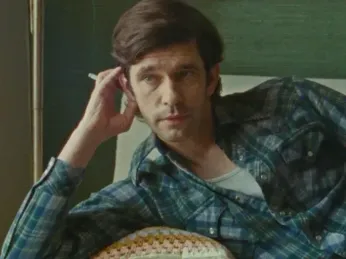
If you ever wondered what it was like to live in the early years of gay liberation in the Mecca of LGBTQ freedom, New York, without over-romanticizing that era, then the new experimental, shot on 16mm film, “Peter Hujar’s Day” (Janus Films) directed by the incomparable gay director Ira Sachs and starring Ben Whishaw, the greatest gay actor in the world, provides that snapshot.
On one level, this film resembles a theatrical monologue, yet it’s a film that calls to mind some of Andy Warhol’s early 1960s films which record almost silent observations of typical daily life, such as a man eating a mushroom or a couple kissing. In fact, “Peter Hujar’s Day” is one ordinary day in the life of an artist in a vanquished time, thriving in a city where there was cheap rent which gave you the freedom to make any money you could accrue to survive.
Anyone under 50 might not be acquainted with Peter Hujar (1934-1987). Hujar was a gay American photographer best known for his black-and-white portraits. Two of his famous photos are the Warhol transgender actress “Candy Darling on Her Deathbed” and “The Orgasmic Man,” a man in sexual ecstasy or agony, most famously used on the book cover of Hanya Yanaghihara’s novel, “A Little Life.” In the early 1980s Hujar met artist David Wojnarowicz, became his lover, then mentor, promoting his art for the rest of his life.
During his lifetime, Hujar published only one book of his photos, “Portraits in Life and Death,” (republished last year), had only one major exhibition, and received marginalized recognition. He and his work were overshadowed by his contemporary, the more famous and controversial gay photographer Robert Mapplethorpe, whom he knew and occasionally worked.
Both men focused on portraits and homoerotic themes. Hujar died of AIDS. However, in the last decade his work has been rediscovered, thanks to the Yanaghihara photo but also as society reevaluates and reappreciates the creative artistry lost during the AIDS holocaust. Hujar was the subject of a much praised 2018 exhibition at the Morgan which had purchased his papers and photos in 2013.
The film is based on rediscovered tapes, considered lost that resurfaced at the Morgan Library archive and was published as a book in 2021, which was discovered by Sachs in a bookstore. It’s a 1974 interview by nonfiction writer Linda Rosenkrantz, still alive today at 91 (played by Rebecca Hall) in which she asked creative artists to narrate the events of their previous day in minute detail into a tape recorder (long before electronic devices), almost like a verbal version of Virginia Woolf’s “Mrs. Dalloway.”
Sachs wrote a screenplay based on Hujar’s words to develop this two-character film, a queer version of “My Dinner with Andre,” recreating a bygone era as we are enmeshed in an almost cinema verité rendition of its queer countercultural and bohemian milieu. What could have been gimmicky is perceptive and even poignant, especially as we witness two people who genuinely enjoy each other’s company which allows a letting down of one’s guard, as a bond of friendly intimacy is forged, even to the point of lying together on her bed, his head in her lap. Other times it resembles a therapy session complete with Hujar reclining on a sofa.
Because he was barely surviving economically being poor and eating little, Hujar took on commercial projects one of which he relates and is the peak of the film: a photograph of gay beat poet Allen Ginsberg for the New York Times. Ginsberg was unpleasant and difficult throughout the shoot. Hujar isn’t pleased with the final images. He realizes he hasn’t connected with this subject and it shows in the pictures. He decides Ginsberg wasn’t attracted to him, leading to the disappointing results, which incurs self-doubt in Hujar.
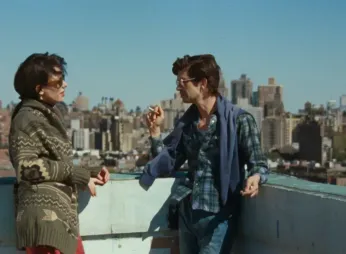
There are phone calls from intellectual Susan Sontag (a friend and supporter) and writer Fran Leibowitz as well as from a horny lover who wants to hook up with him. It’s all casual with Hujar being a gossipy jokester with his sarcastic asides, present in the moment small details between two friends in a relaxed reporting of events whether it be the price of cigarettes, his worsening eyesight, taking a brief nap, figuring out how much money his commercial work will amount, pouring tea for each other or admitting how frequently he lies, eating Chinese takeout food at night, as they climb to the roof to continue their chain-smoking and banter.
In one sense nothing of consequence is happening, yet in another psychologically he’s reassessing his life and what he wants to accomplish. Yet the film serves as commentary on the small ways we spend our days, that it all might be more profound than we think.
For Hujar there’s not much difference between daily life and being creative. They bleed into each other. There’s a fourth wall breaking moment when we get a glimpse of Sach’s crew positioning a mic over the actors who are constantly moving, but mostly it feels like friendly inviting voyeurism cocooned in a docudrama.
Whishaw not only embodies Hujar but in his movements, moods, looks, and gestures, witty delivery, the way he can change the position of his body or posture, seems to inhabit the ethos of the era, carefree but determined to get ahead. He’s constantly paying attention to his surroundings. You would think he and Hall had been friends for a lifetime, even though they just met on set. Hall has little to do but listen intensely and react to Hujar’s observations.
Yet the film excels at showing why gay men get along so famously with straight women, namely an easygoing candor that they can talk about anything without sex getting in the way or being misinterpreted, exuding playfulness and warmth. These are two artists who love what they do and we get to eavesdrop.
For viewers craving action, this film will not be satisfying even boring, stagey, or feel like an elongated talk show interview. There are so many obscure references to arts figures of the 1960s and ’70s, some now forgotten, that there’s a list and description of them in the press kit.
Yet to others, it will seem as if Hujar has been resurrected and we get to spend a day in his presence relishing his deep observations about art, friendship, sexuality and the costs of being gay, that at times can feel mesmerizing. It’s also a portrait of a long-gone New York City with its ghosts temporarily summoned. Its message of being willing to listen intently to others has a resonance that I found moving in the era of cruelty, where people with different views are seen as enemies, not as potential for dialogue or unexpected insights.
‘Peter Hujar’s Day’ screens at the Roxie SF thru Dec. 6.
https://roxie.com/film/peter-hujars-day/