Oct 24
‘Blue Moon’ – Ethan Hawke stars as the tragic gay lyricist Lorenz Hart
Brian Bromberger READ TIME: 1 MIN.
Few know the name of Lorenz Hart (1895-1943) today, but along with his musical partner Richard Rodgers, they were the most famous Broadway songwriting duo in the first half of the twentieth century. Hart wrote the words, Rodgers the music. They were the Lennon and McCartney of their era.
And though his name may have been forgotten, the songs he wrote with Rodgers such as “My Funny Valentine,” “The Lady Is A Tramp,” “Isn’t It Romantic?,” “Bewitched, Bothered, and Bewildered,” “Manhattan,” and “Blue Moon” are very much remembered in the 26 musicals (“Pal Joey,” “The Boys from Syracuse,” “Babes in Arms”) they created in over 20 years.
Director Richard Linklater’s new film “Blue Moon” (Sony Pictures Classics), named after the song, tells the sad tragic story of Hart as his professional life unraveled at the opening night party for his former partner’s hit show “Oklahoma,” with his new lyricist Oscar Hammerstein. Following that night over the course of 17 years, Rodgers and Hammerstein became the most successful songwriting team in American musical theater history (“South Pacific,” “Carousel,” “The King and I,” “Sound of Music”), overshadowing his work with Hart.
Sharp wit
Many critics now consider Hart among the greatest American lyricists, with the notable exception of Cole Porter. His lyrics have a sharp wit, but are also bittersweet and melancholy. He was a short man, standing below five feet tall with a lousy comb-over, considered himself ugly, but was a captivating raconteur with a charismatic personality. He was a closeted Jewish homosexual (an open secret of that era) who was addicted to alcohol, acting as a painkiller, which destroyed his partnership with Rodgers. The film also serves as a kind of breakup movie, despite their love for each other as artists (Rodgers was straight).
The film opens with an inebriated 47-year-old Hart (Ethan Hawke) falling down drunk in the street in late 1943, then dying of pneumonia a few days later. Then the film circles back to that opening night party eight months earlier in the bar at Sardi’s. He watches the premiere of “Oklahoma” with his mother and walks out on the show’s title number.
He hates the show, criticizing its sentimentality, corniness, and phoniness. He’s bitter and jealous because he recognizes the show is a landmark achievement, even though he didn’t write it. We later find out he was invited by Rodgers to write some songs, but was too incapacitated to finish them.
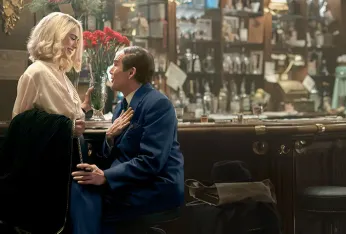
He vents to Eddie the bartender (the terrific Bobby Carnavale). Although he swears he’s on the wagon, he sweet talks Eddie into pouring him drinks, that at first he just gazes at and admires, but later gulps down greedily to drown his sorrows. He’s waiting for twenty-year-old beautiful college student Elizabeth Weiland (Margaret Qualley) of whom he’s enamored. He wants that night to be the one he confesses his love for her, despite his insecurity and self-hatred, and the fact that everyone around him assumes he’s gay.
Double humiliation
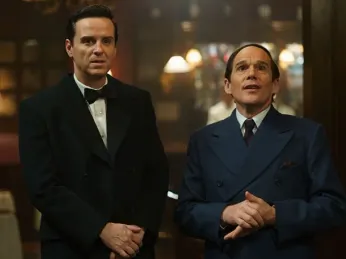
Rodgers (Andrew Scott) and Hammerstein arrive to triumphant applause and rave reviews. Hart is facing two possible humiliations, as he now feels he’s a has-been, obsolete. He’s rather sarcastic to Rodgers, though praises “Oklahoma” in the hope they can continue their professional partnership. Rodgers wants him to write some new songs for a revival of their popular show, “A Connecticut Yankee,” though he insists Hart quit his drinking binges. Rodgers recognizes he owes his career to Hart and doesn’t want to abandon him, despite resenting his lack of professionalism and self-discipline. He also clearly relishes his success with Hammerstein.
When Elizabeth arrives, she’s fond of him but not attracted to him, despite showing him tenderness as he weaves a fantasy of a romantic future with her. It’s her beauty that beguiles him. He lives vicariously by listening to her sexual shenanigans with a college boy. She’s not quite the ingenue Hart thinks she is and is ambitious to advance her theatrical career as a scene designer, hoping Hart’s connections will open doors for her. As the movie progresses, it becomes clear that Hart knows his best work is behind him, but can’t admit it to himself.
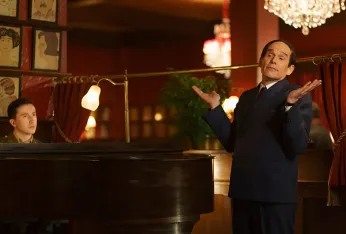
The film is primarily an almost non-stop monologue by Hart with a few interruptions. If you hate talky movies, “Blue Moon” should be avoided. Yet the film is never dull, even though there’s virtually no action occurring except to observe Hart’s ever-deepening desperation and anguish, which is not to say Hart has his insufferable moments and there are times audiences will wish he would just shut up.
Deep wounds
The film would fail if the right actor wasn’t cast as Hart. Fortunately, Hawke gives probably the greatest performance of his career, which with any justice should nab him a Best Actor Oscar nomination. With makeup and clever camera angles to make you think he’s much shorter than he really is, Hawke is unrecognizable and embodies this vivid character in all his contradictions.
He conveys the pathos, fierce talent, and the loneliness of the closet, but also the deep wounds that are the core of who he is. The film adroitly conveys how the theater was a safe space for gay men, though it didn’t protect them from derision or downfall if a scandal occurred. There’s a melancholy tone that pervades the film, probably because we know in a few months Hart will be dead.
Scott does reams with little dialogue, conveying both his admiration and exasperation of Hart nonverbally. He’s able to take the focus off Hart for a few minutes which feels like relief after so much unending chatter. Scott reveals the intimacy of their friendship, but also as Rodgers the need to move on, that is bittersweet but also divulges an ambitious talent.
This is the seventh film Linklater has made with Hawke, including the “Before” trilogy and “Adulthood.” Theirs may be the best actor/director collaboration since John Wayne/John Ford or Jimmy Stewart/Cary Grant/Alfred Hitchcock.
Only they could make a movie that takes place in more-or-less one room visually yet is fast moving and dramatically compelling, just avoiding staginess. Still by its conclusion, some viewers will find it a bit exhausting and perhaps claustrophobic. It’s a study in anguished hopefulness and frailty bleeding into despair of a musical genius who wanted to be loved, yet was destroyed by his own worst instincts. It’s a penetrating and at times flawed elegiac triumph, which might induce ecstasy in musical theater buffs.
‘Blue Moon’ screens at AMC Metreon 16 and Cinemark Daly City Century 20.
http://www.sonyclassics.com/film/bluemoon