Oct 13
‘Kiss of the Spider Woman’ – an entangled musical web of romance and intrigue
Brian Bromberger READ TIME: 1 MIN.
The new film “Kiss of the Spider Woman” has a complicated history. First, let’s be clear which version to which we’re referring. It’s based on the famed 1976 novel by the gay Argentinian writer Manuel Puig, which was made into a 1985 film starring William Hurt, Raul Julia, and Sonja Bragg. Nominated for four Oscars, the straight Hurt won Best Actor, the first time an actor was awarded for a gay role.
However, this adaptation is not a remake of the film. In 1992/1993 it was transformed into a Broadway musical with music by John Kander and Fred Ebb, the gay duo of “Cabaret” and “Chicago,” based on a book by the late gay playwright Terence McNally, starring the late incomparable Chita Rivera and the gay Brent Carver. It combined a grim prison drama with the frothy razzle dazzle of an Old Hollywood musical, winning seven Tony Awards, including Best Musical.
This latest film released by Lionsgate, is a goulash of political persecution, camp, queer romance, and song and dance, switching back and forth between the harsh realities of an austere, repressive world versus lush cinematic fantasy, a precarious balance at best.
Passion & repression
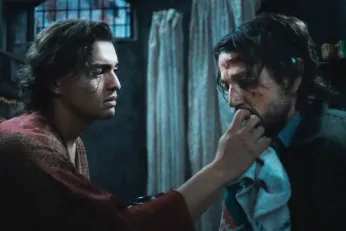
It’s Argentina, 1983 and the country is ruled by a military dictatorship bent on destroying all its political enemies, which sadly sounds very familiar in 2025. Two prisoners in Buenos Aires share a prison cell, Valentin (Diego Luna), a cranky unrepentant Marxist revolutionary who’s being tortured to name other political dissidents, and Molina (Tonatiuh), a flamboyant ‘gay’ window dresser serving time for engaging in public indecency with another man. They couldn’t be more different, one symbolizing ideology, the other fantasy.
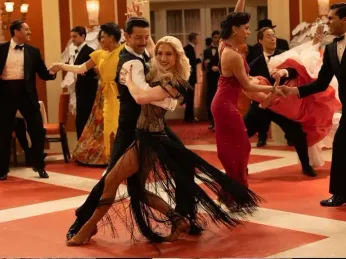
To pass the time, Molina describes his favorite film, “Kiss of the Spider Woman,” a dazzling Technicolor melodrama circa Hollywood 1940s starring Golden Age movie star siren Ingrid Luna (Jennifer Lopez). The movie is set in a Latin American locale, where she falls in love with two men (played by Luna and Tonatiuh), while trying to flee a mythical predator (also played by Lopez), whose kiss means death.
The musical is reenacted in a kind of mind palace, as a way of escaping their harsh reality, and over time it mirrors Valentin and Molina’s lives. They share stories and confessions and become closer, with the possibility of love despite the horrific environment bent on crushing the human spirit.
Unbeknownst to Valentin, Molina has been put in their cell by the warden (Bruno Bichir) to spy on him. Valentin is being poisoned in his food, giving Molina a chance to help befriend, and seduce him, with the possibility he will open up to him and reveal the names of his fellow activists and information about the resistance. If he succeeds, Molina will be paroled and returned home to his beloved mother.
Identity & desire
The film speaks to the universal struggles of identity, desire, and the human need to escape with storytelling as an act of consolation and liberation. The main qualm with the film is gay director Bill Condon (“Gods and Monsters,” “Dreamgirls”) decidedly favors the Hollywood sequences.
The prison scenes come across as stagey and sanitized, a Hollywood incarnation of what a 1980s Latin American cell might resemble. They lack any sense of real menace. The warden character is a cartoonish villain. This all means we don’t really take the harrowing political ramifications here seriously. Condon wants to avoid being too theatrical or too political, so we’re left somewhere in the unsatisfying ambiguous middle.
The characters from the 1985 film have changed both for good and worse. Valentin is much less explicitly homophobic, not calling Molina a faggot all the time, which feels good in terms of political correctness, but makes us sympathetic to the character. That initial conflicting tension between he and Valentin is lost and feels contrived.
Molina is imprisoned for public sex, not for corrupting an underage youth. Also, this film hints strongly that Molina is trans, constantly reiterating not only that he wants to look like Ingrid/Aurora, but he wants to be her, a woman, which was barely mentioned in the 1985 film. Unlike the 1985 film, where Molina is describing a Nazi propaganda movie, in 2025 it’s a Hollywood musical. In short, all the hard edges have been softened, so the contrast between prison and the film isn’t as sharp as it should be.
Glamour & grime
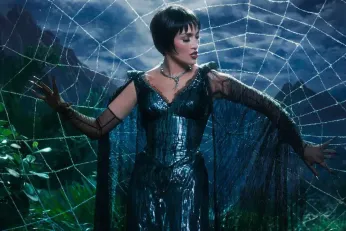
The sets in the musical sequences are artificial looking. It’s obvious that expense was spared, though the glitzy costumes and makeup are outstanding with thrilling dance numbers. The production design has a threadbare quality to it.
Condon made the wise decision of cutting out the songs sung by Valentin and Molina in prison to make a keener contrast between gritty prison life and screen escapism. The songs are serviceable but mostly forgettable, hardly Kander/Ebb’s best. The title song, a dance of seduction and death, is by far the winner here, aided by both beautiful and terrifying choreography.
The acting is the highlight of “Kiss of the Spider Woman.” Luna is fine as Valentin but has the easiest job of the three leads. He has convincing chemistry with Tonatiuh so you believe his reevaluation of his relationship to Molina from annoying to caring.
Tonatiuh is the revelation here in a breakout performance. He’s campy, but not in a stereotypical way that Hurt was. Instead, he projects a natural femininity and vulnerability, so you accept his transformation to lovelorn activist.
Hurt’s performance doesn’t hold up well 40 years later. He’s exaggeratingly femme and uses every gay cliché in the book, which Tonatiuh (who identifies as queer Mexican-American) avoids. He deserves an Oscar nomination but may be hindered by the film’s mixed reception.
Lopez acquits herself well. She’s mentioned in interviews this was the role she was born to play, that she wanted to appear in a Hollywood-type musical since childhood. She even convinced her husband actor Ben Afleck, whom she later divorced a second time, to finance the movie.
She obviously relishes her role, and exudes a personal magnetism. Her singing is good, but her dancing is far better. If you really want to hear mesmerizing interpretations of these songs, listen to Chita Rivera in the Broadway soundtrack album. Rivera wasn’t afraid to indulge in the campy aura of the role and the movie itself, while Lopez seems restrained.
Still, a Best Supporting Actress nomination appears likely, as she’s quite proficient at differentiating the three roles she plays: Ingrid, Aurora, the vampy diva fashion magazine editor looking for love, and the Spider Woman.
Even with these flaws, the film is well worth watching, particularly for the acting. Audiences needn’t fear they are going to be bombarded with overt political messages. The 1985 incarnation is the one to watch for that perspective.
To combine two wildly different genres would be a challenge for any director, but the 1985 film favored the prison scenes which have greater dramatic force than the melodramatic musical numbers in the 2025 version. However, it’s possible the movie will resonate with audiences today, because of its view of the power of art as consolation for unhappiness, when one is unable to effect real change or avoid tragedy. This speaks to our current predicament on the impact of a repressive regime.
Overall, it’s a miss, but a lofty one. You might exit the theater exhilarated by the invincibility of love, even in the most dire of situations.
‘Kiss of the Spider Woman’ (Lionsgate/Roadside Attractions) plays at AMC Kabuki, the Regal Stonestown Galleria, and Apple Cinemas Van Ness IMAX.
https://www.kissofthespiderwomanfilm.com/