Dec 10
US Supreme Court declines case of Bakersfield baker’s appeal over same-sex wedding cake
John Ferrannini READ TIME: 4 MIN.
The U.S. Supreme Court declined to take the case of a Bakersfield baker who refused to make a wedding cake for a same-sex couple. The action is a win for the state’s Office of Civil Rights, which initially filed the lawsuit several years ago.
Earlier this year, a panel of the California 5th District Court of Appeal ruled against Catharine Miller, owner of Tastries Bakery in Bakersfield. The panel held in the case, titled California Civil Rights Department v. Tastries, that under the Unruh Civil Rights Act, the bakery had to provide equal services to lesbian couple Mireya and Eileen Rodriguez-Del Rio, who claimed a scheduled tasting in 2017 was canceled once bakery owner Miller realized they were a same-sex couple. (The Unruh Act was named for the late Jesse M. Unruh, the once-powerful state Assembly speaker who authored it in 1959. Sexual orientation was added in 2005.)
The suit was brought by the state civil rights department. Miller appealed to the U.S. Supreme Court, which, without comment, declined to hear her appeal December 8.
The Becket Fund for Religious Liberty, which represents Miller on this matter, expressed disappointment, and lauded Miller’s courage.
Adèle Keim, senior counsel at Becket, stated, “Cathy has shown remarkable courage over the last eight years. We’re disappointed the Court declined to hear Cathy’s case, and we are evaluating Cathy’s options for continuing to run Tastries in a way that reflects her faith.”
For her part, Miller said she will continue to practice her religious beliefs.
“I’m disappointed the court chose not to take my case, but my trust remains in Jesus Christ,” Miller stated. “For over a decade, I’ve welcomed everyone who comes into Tastries with the care and honesty my faith calls me to, and I’ll continue doing exactly that. This isn’t the result I prayed for, but I am sure God will use this for his glory. I will continue to work to use my creative skills to bless others and reflect my faith in Jesus.”
California Civil Rights Department Director Kevin Kish stated, “The U.S. Supreme Court’s order leaves in place a key appellate court decision that affirms the civil rights of people all across California.”
“You cannot deny someone service by claiming a predesigned, multipurpose cake is protected speech,” Kish continued. “Every Californian is entitled to full and equal services at businesses in our state. I applaud Eileen and Mireya Rodriguez-Del Rio for speaking out and standing up for their rights. No matter your religion, sexual orientation, or other aspects of who you are, we’re committed to protecting all our communities from discrimination.”
The unanimous state appellate opinion was authored by Associate Justice Kathleen Meehan, who stated "intentional discrimination" was established by Miller's policy to refer the lesbian couple to another business, and that designing a plain, white cake with no writing did not constitute protected speech.
"Under our independent review, we conclude defendants' refusal to provide the Rodriguez-Del Rios the predesigned, multi-purpose white cake requested was not protected expression under the federal Constitution's free speech guarantee," Meehan wrote. "A three-tiered, plain white cake with no writing, engravings, adornments, symbols or images is not pure speech."
The case is reminiscent of another U.S. Supreme Court case that gained national headlines, Masterpiece Cakeshop v. Colorado Civil Rights Commission, in which the nation’s highest court in 2018 ruled 7-2 in favor of baker Jack Phillips, who would not bake a cake for a same-sex couple due to his religious beliefs. The court found that a Colorado commission was biased against Phillips' religious beliefs – thus avoiding the broader questions about anti-discrimination laws and the First Amendment, which have become increasingly salient as LGBTQ people have gained legal protections.
The imbroglio at Tastries started seven years ago when a mixed-sex group, including the lesbian couple, came to the shop for a scheduled tasting, Miller's legal brief states.
"Upon their arrival, Miller believed these five were the bride and groom along with the maid of honor, the best man, and a mother," Miller's brief stated. When she realized "a few minutes into the consultation" that this was a request for a same-sex wedding cake, Miller 'explained that she could not make their wedding cake because doing so would violate her Christian beliefs. Miller offered to connect them with a different custom wedding cake designer.'"
A state investigation into Miller was opened in October 2017 after the same-sex couple filed a formal complaint, the brief states.
In 2018, the department determined Miller had violated the Unruh Act. Meehan ruled that referring the couple to the separate business did not meet the act's non-discrimination requirements.
"We find no sufficient support for defendants' contention the CRD demonstrated hostility toward Miller's religion in violation of the neutrality that the federal Constitution's First Amendment's free exercise clause requires," Meehan ruled.
Last year, several civil rights groups filed amicus briefs in support of the state's appeal, as the Bay Area Reporter noted at the time. One of them was the Lawyers' Committee for Civil Rights of the San Francisco Bay Area.
"Tastries' refusal to sell a blank, white cake base to a lesbian couple based on their sexual orientation is unequivocally illegal," Nisha Kashyap, a racial justice program director with the committee, told the B.A.R. at the time.
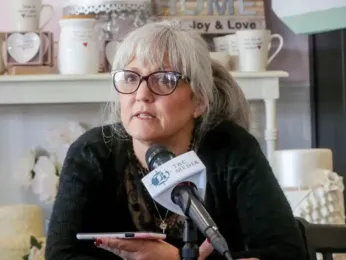
The U.S. Supreme Court declined to take up an appeal from Catharine Miller, owner of Tastries Bakery in Bakersfield, who lost a state court case after she refused to make a wedding cake for a same-sex couple because of her religious beliefs. Photo: AP/Harry Barrios